Working at height remains one of the leading causes of workplace injury in the UK, and footwear plays a bigger part in that risk than many buyers realise. It’s not just about protecting your feet if something falls, it’s about the grip, stability, and support that keep you safely on a ladder, roof, or scaffold platform in the first place.
If you’re buying safety footwear for a team that works on ladders, scaffolding, roofs, or elevated platforms, here’s what to check before you buy.
Why footwear matters for working at height
Under the Work at Height Regulations 2005, employers have a duty to assess and control the risks of working at height — and appropriate PPE, including footwear, forms part of that risk control. Footwear that grips poorly, fits badly, or doesn’t support the ankle can directly contribute to slips, trips, and falls, which is precisely the hazard height-safety measures are designed to prevent.
In other words, the footwear isn’t a secondary consideration alongside harnesses and guardrails — it’s part of the same control system.
Check the grip and slip resistance rating
Grip is a key consideration for anyone climbing ladders or working on scaffolding, sloped or wet surfaces. Under EN ISO 20345:2022, safety footwear is tested for basic slip resistance on ceramic tile with a soap solution.
You should also look for these additional optional markings
- SR (slip resistance): Indicates that the footwear has passed the additional more demanding glycerine-on-ceramic-tile slip-resistance test.
- LG (ladder grip): Shows the footwear is designed with specific outsole and heel geometry to improve grip and stability on ladder rungs helping the footwear engage securely with a rung.
Footwear carrying both LG and SR markings provides a strong combination of ladder grip and additional slip-resistance performance. If your team regularly uses ladders, ask your supplier whether the footwear carries LG as well as SR. The two markings address different aspects of grip, so one should not be assumed to replace the other.
If your team is regularly on ladders, ask your supplier specifically whether a boot carries an LG rating, rather than assuming SR covers it.
Prioritise ankle support and a secure fit
A boot that moves on the foot is a liability on a ladder rung or a narrow platform edge. Two things to look for:
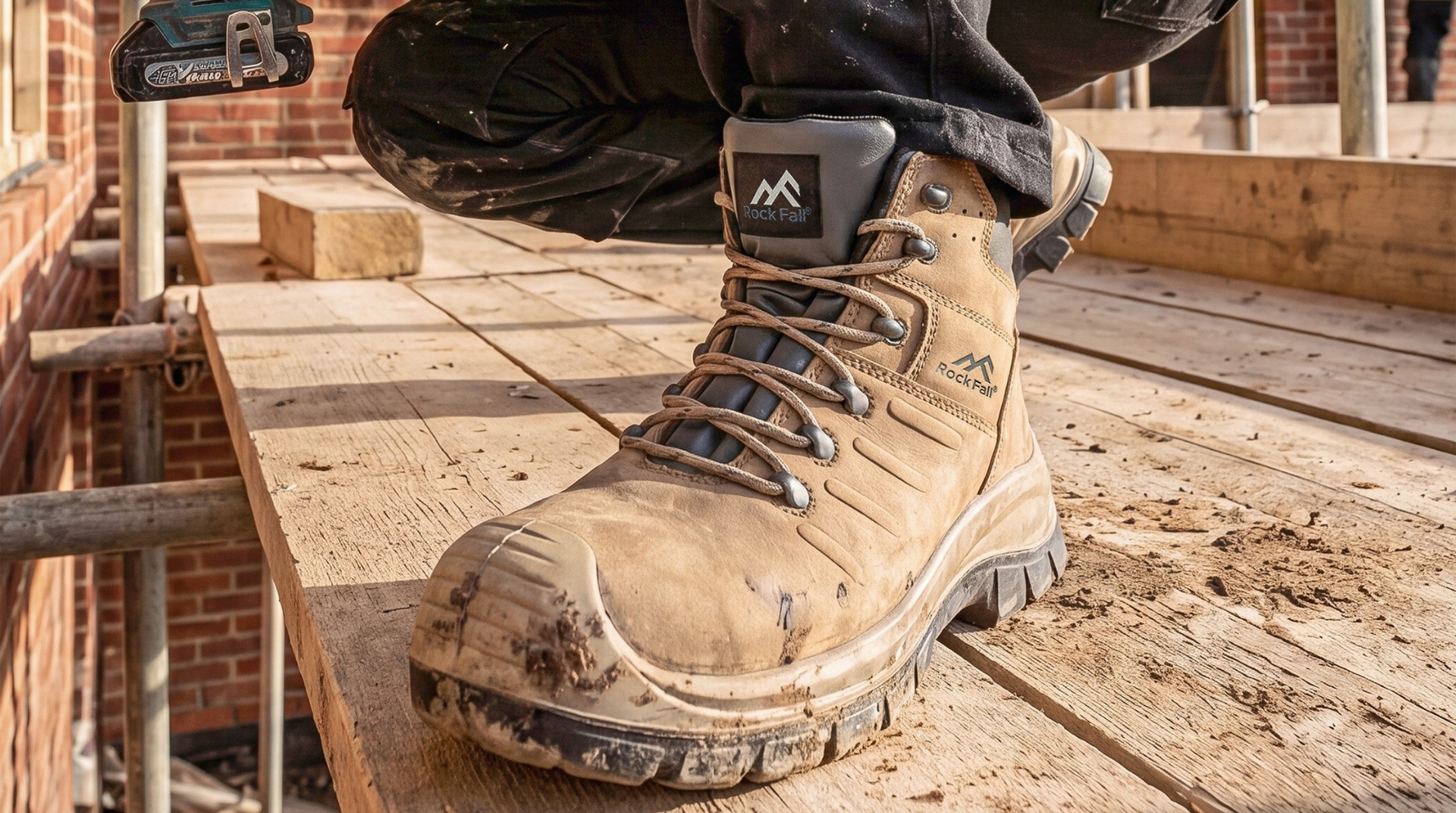
- Boot height: Higher-leg boots that sit above the ankle can offer more lateral support than a low-cut safety shoe or trainer-style boot. Rock Fall’s Boone (RF750), for example, has a 7-inch leg that extends above the ankle for exactly this kind of support.
- Fastening: A secure, adjustable fastening such as laces, or a side-zip closure, keep the boot locked to the foot without loosening over a shift, which matters more when the wearer is repeatedly climbing and descending.
A boot that’s the wrong fit undermines every other safety feature it has. Rock Fall’s sizing and fit guide is worth checking alongside this one.
Don’t overlook weight and flexibility
Climbing a ladder repeatedly, or spending a shift crouched on a roof, is physically demanding in a way that flat groundwork often isn’t. Heavy, stiff boots tire the legs faster and could make it harder to feel the rung or edge underfoot — both of which affect safety, not just comfort.
This is a wider trend across the safety footwear market, not a Rock Fall-specific claim. Buyers are increasingly prioritising lighter-weight, comfort-focused footwear without dropping protection levels, as boot technology – such as better midsoles and engineered footbeds, has improved. When comparing options for height work, weigh up:
- Overall boot weight
- Sole flexibility (a very rigid sole can reduce your sense of the surface underfoot)
- Cushioning/anti-fatigue footbeds for long shifts on ladders or platforms
Confirm the protection level you actually need
Not every height role needs the same spec. Check the job against the standard protection classes under EN ISO 20345 (S1–S7), and consider:
- Toe protection: Still essential on most sites, for dropped tools or materials.
- Penetration-resistant midsoles: Relevant on roofs and scaffolds where nails, screws, or debris may be underfoot.
- Waterproofing: Roofers and scaffolders are often exposed to the elements for full shifts. A water-repellent or waterproof membrane upper reduces the risk of a wet, cold foot affecting concentration and grip.
For the full breakdown of standards and classes, see Rock Fall’s complete guide to choosing safety footwear
Match footwear to the specific height task
“Working at height” covers a wide range of jobs, and the footwear priorities shift depending on the task:
| Task | Footwear priority |
| Ladder work (short, repeated climbs) | LG-rated grip, secure fastening, lightweight design |
| Scaffolding | SR slip resistance, ankle support, penetration-resistant midsole |
| Roofing | Flexible sole for surface feel, waterproofing, grip on sloped/wet surfaces |
| Elevated platforms/MEWPs | Comfort for standing for long periods, ESD/anti-static if working near electrics, slip resistance |
If your team covers more than one of these, it’s worth assessing footwear per task rather than issuing one boot for every scenario.
Quick checklist before you buy
- Confirmed SR (or LG, for ladder-heavy roles) slip resistance rating
- Boot height and fastening give proper ankle support
- Weight and flexibility suit repeated climbing or prolonged elevated work
- Protection class (toe, midsole, waterproofing) matches the actual site hazards
- Correct fit confirmed — a loose or tight boot undermines grip and support
Frequently Asked Questions
Do I need special footwear for working at height, or will standard safety boots do?
Standard EN ISO 20345-rated safety boots provide a baseline, but for regular ladder, scaffold, or roof work, it’s worth checking specifically for grip performance (SR or LG rating) and ankle support, which general-purpose safety boots don’t always prioritise.
What is the LG rating on safety footwear?
LG (ladder grip) is a specific slip-resistance test under EN ISO 20345, distinct from the general SR ratings, designed to assess grip on rungs and narrow edges — directly relevant to ladder-based work.
Is ankle support a legal requirement for working at height?
The Work at Height Regulations 2005 don’t specify a particular boot height, but employers must assess and control fall and slip risks. Footwear that provides poor ankle stability can factor into that risk assessment.