Phosphorescent safety boots are work footwear featuring glow-in-the-dark panels that charge in minutes and emit visible light for hours—without batteries. Using advanced photoluminescent materials, these boots absorb energy from sunlight or artificial light and release it as a continuous glow, keeping wearers visible in low-light and no-light environments where traditional reflective materials require a light source to work.
This guide explains exactly how phosphorescent technology works, why it represents a significant advancement over reflective-only solutions, and how Signal Lucence dual technology is changing workplace visibility standards.
Table of Contents
- What Are Phosphorescent Safety Boots?
- Understanding Photoluminescence
- Phosphorescence vs Fluorescence: Key Differences
- The Science: How Phosphorescent Boots Work
- Signal Lucence: Dual Technology Explained
- Charging Times and Light Sources
- Durability and Longevity
- Real-World Performance
- Industries and Applications
- Frequently Asked Questions
What is Phosphorescent Safety Footwear?

Phosphorescent safety boots are protective footwear incorporating photoluminescent panels that absorb light energy and emit a visible afterglow in darkness. Unlike reflective materials that passively bounce light back, phosphorescent materials actively generate their own light output.
The technology enables wearers to remain visible for up to 8 hours in complete darkness after just 5 minutes of light exposure. This addresses a critical safety gap: the moments when there is no external light source for reflective materials to reflect.
Key Characteristics
| Feature | Specification |
|---|---|
| Charge time | 5 minutes (natural sunlight) 10 minutes (artificial light) |
| Glow duration | Up to 8 hours (without further light top-ups) |
| Power source | Light energy (self-charging) |
| Batteries required | None |
| Maintenance | Routine cleaning (clean panels for optimal performance) |
| Technology lifespan | Lifetime of footwear |
Rock Fall’s Ultimate Visibility safety footwear range—including the Sirius RF603 and Canopus RF604—uses this technology through a partnership with Coats® Signal™ Lucence™.
Understanding Photoluminescence
Before examining how phosphorescent boots work, it helps to understand the broader science of photoluminescence, the process by which materials absorb and re-emit light.
What Is Photoluminescence?
Photoluminescence is the emission of light by a material after it has absorbed photons (light energy). The material doesn’t burn or undergo chemical change; it simply converts absorbed light energy into visible light output.
There are two main types of photoluminescence:
- Fluorescence: Light is absorbed and re-emitted almost immediately (within nanoseconds)
- Phosphorescence: Light is absorbed, stored, and released gradually over minutes to hours
The crucial difference is time. Fluorescent materials stop glowing the instant you remove the light source. Phosphorescent materials continue glowing long after—this is what makes them valuable for safety applications in darkness.
The Role of Phosphors
The glow comes from phosphors, crystalline compounds that store and release light energy. Modern safety applications use strontium aluminate phosphors, which offer:
- Brighter afterglow than older zinc sulphide phosphors
- Longer glow duration (hours vs minutes)
- Greater stability and durability
- Non-toxic, non-radioactive composition
- Resistance to moisture and UV degradation
Strontium aluminate was developed in the 1990s and represents a 10× improvement over previous glow-in-the-dark materials, making practical safety applications viable for the first time.
Phosphorescence vs Fluorescence: Key Differences
Understanding why phosphorescence, not fluorescence, is used in safety boots requires examining how each process works at the atomic level.
Fluorescence: Immediate Release
When fluorescent materials absorb UV light:
- Electrons become excited and jump to a higher energy level
- Electrons immediately fall back to their ground state
- Energy is released as visible light instantaneously
- Glow stops when the light source is removed
Example: High-visibility yellow and orange clothing uses fluorescent dyes. They appear brighter in daylight because they convert invisible UV light into visible wavelengths. But in complete darkness with no UV source, they provide no visibility benefit.
Phosphorescence: Delayed Release
When phosphorescent materials absorb light:
- Electrons become excited and jump to a higher energy level
- Electrons become trapped in a metastable state
- Energy is stored in the crystal lattice
- Electrons gradually escape, releasing energy as light over hours
- Glow continues long after the light source is removed
Key insight: The “trapping” mechanism is what creates the extended afterglow. Electrons are held in an excited state by the crystal structure and can only escape slowly, creating sustained light emission.
Side-by-Side Comparison
| Property | Fluorescence | Phosphorescence |
|---|---|---|
| Light emission timing | Immediate (nanoseconds) | Delayed (minutes to hours) |
| Glow duration | Only while lit | Hours after charging |
| Works in total darkness | No | Yes |
| Requires continuous light | Yes | No (after initial charge) |
| Energy storage | None | Stored in crystal lattice |
| Safety application | Daytime visibility | Night/dark visibility |
For safety footwear, phosphorescence is essential because it provides visibility precisely when reflective and fluorescent materials cannot: in complete darkness with no light source.
The Science: How Phosphorescent Safety Footwear Works
Here’s the step-by-step process by which phosphorescent safety boots charge and glow:
Step 1: Light Absorption
Phosphorescent panels on the boot are exposed to a light source, sunlight, artificial lighting, or UV light. The photons (light particles) carry energy that enters the phosphorescent material.
What happens: Photon energy is transferred to the strontium aluminate crystals embedded in the panel material.
Step 2: Electron Excitation
When photons strike the phosphor crystals, they transfer energy to electrons within the atomic structure. This energy “excites” electrons, causing them to jump from their normal ground state to a higher energy level.
What happens: Electrons absorb photon energy and move to an excited state, similar to compressing a spring.
Step 3: Energy Trapping
Unlike fluorescence where electrons immediately fall back, phosphorescent electrons become trapped in a metastable state. The crystal structure of strontium aluminate creates “energy wells” that hold electrons at their elevated energy level.
What happens: Excited electrons are trapped and cannot immediately return to the ground state. The energy is effectively stored.
Step 4: Slow Light Release
Over time, thermal energy (ambient heat) allows trapped electrons to gradually escape the metastable state and return to ground level. As each electron falls back, it releases its stored energy as a photon of visible light.
What happens: Electrons slowly release stored energy as light, creating a sustained afterglow that diminishes gradually over hours.
The Result
This four-step process creates continuous light emission for up to 8 hours from a single 5-minute charge. The glow is brightest immediately after entering darkness and diminishes gradually but remains visible to the human eye throughout the duration. In the meantime, any additional exposure to a light source effectively tops up the energy well to enable light emission beyond the original 8 hours.
Charging Times and Light Sources
A critical advantage of phosphorescent boots is their rapid charging capability. Unlike battery-powered alternatives that require hours of electrical charging, phosphorescent materials charge in minutes through simple light exposure.
Charging Time by Light Source
| Light Source | Light Intensity (Lux) | Time for Full Charge |
|---|---|---|
| Clear sunlight | >50,000 lux | 5 minutes |
| Cloudy daylight | 3,000–50,000 lux | 5 minutes |
| Dusk/dawn | ~1,000 lux | 8 minutes |
| Fluorescent office lighting | ~500 lux | 10 minutes |
| UV light source | Variable | 5–10 minutes |
Practical Charging Scenarios
Ultimate Visibility safety footwear has the advantage of charging “on the go”.
Outdoor workers: Simply wearing the boots outdoors during a break, lunch, or travel time provides sufficient charging. Even on overcast days, ambient daylight delivers enough energy for a full charge.
Indoor-to-outdoor transitions: Workers moving from artificially lit indoor areas to dark outdoor environments will have partially charged boots from indoor lighting, supplemented by any outdoor light exposure.
Underground/tunnel work: Boots can be charged before entering dark environments using daylight, vehicle headlights, or dedicated UV charging solutions such as UV torches. Charging is also “topped up” whenever workers return to lit areas.
Continuous indoor work: Fluorescent and LED office/warehouse lighting provides ongoing low-level charging. While glow intensity may be lower than sunlight-charged boots, visibility is maintained.
Important Notes
- Partial charges still work: Even brief light exposure provides some glow duration
- Charging is cumulative: Multiple short exposures add up
- No overcharging: Boots cannot be “overcharged” or damaged by extended light exposure
- Temperature independent: Charging works in all temperature conditions
Durability and Longevity
A common question about phosphorescent technology is whether it “wears out” over time. The answer is reassuring for safety footwear investment.
Technology Lifespan
Signal™ Lucence™ phosphorescent panels are engineered to last the lifetime of the footwear. Modern strontium aluminate phosphors maintain their charging and emission capabilities through:
- Thousands of charge/discharge cycles without degradation
- Exposure to moisture, heat, and UV without significant performance loss
- Physical abrasion and flexing typical of work boot use
- Years of regular service in demanding environments
The phosphorescent crystals are embedded within protective panel materials that shield them from physical damage while allowing light transmission for charging and emission.
Maintenance Requirements
Phosphorescent safety boots require minimal maintenance to keep the visibility technology performing optimally.
Do:
- Keep panels clean; dirt and mud reduce light absorption and emission
- Clean with warm water and mild soap
- Allow boots to dry naturally
- Ensure panels are exposed to light when not in use (avoid storing in complete darkness for extended periods)
Don’t:
- Use harsh chemicals or solvents on panels
- Abrade panels with stiff brushes
- Cover panels with tape, paint, or permanent coatings
Key point: Like headlights on a car, a build-up of dirt makes them less effective. The cleaner the panels are kept, the more effective they are.
Performance Over Time
While phosphorescent materials don’t “run out,” glow intensity may reduce slightly over several years of heavy use due to surface wear on panels. However, the technology remains effective throughout the footwear’s service life, and boots will typically require replacement for structural wear before phosphorescent performance becomes inadequate.
Real-World Performance
Understanding specifications is useful, but real-world performance is what matters for safety.
Visibility Distance
Phosphorescent boots are visible to the human eye at significant distances in darkness:
| Time After Entering Darkness | Approximate Visibility Distance |
|---|---|
| 0–30 minutes | 50+ metres |
| 30–60 minutes | 30–50 metres |
| 1–4 hours | 15–30 metres |
| 4–8 hours | 5–15 metres |
Distances are approximate and vary based on observer dark adaptation, atmospheric conditions, and charging quality.
Brightness Decay Pattern
Phosphorescent glow follows a predictable decay curve:
- Initial bright phase (0–30 mins): Strongest emission, most visible
- Sustained phase (30 mins–4 hours): Gradual dimming but clearly visible
- Extended phase (4–8 hours): Lower intensity but still discernible
- Residual phase (8+ hours): Minimal glow, recharge needed
For most work applications, the first 4 hours provide excellent visibility, with the extended phase offering additional safety margin.
Comparison with Reflective-Only Boots
| Scenario | Reflective Boots | Phosphorescent Boots |
|---|---|---|
| Vehicle headlights present | ✓ Visible | ✓ Visible |
| No light source | ✗ Invisible | ✓ Visible (glowing) |
| Worker facing away from light | Limited visibility | ✓ 360° visibility |
| Between vehicle passes | ✗ Invisible | ✓ Visible |
| Power outage | ✗ Invisible | ✓ Visible |
The critical advantage is continuous visibility rather than intermittent visibility dependent on external factors.
Industries and Applications
Phosphorescent safety footwear provide particular value in industries where workers face low-light or no-light conditions.
Industries and Applications
Phosphorescent safety footwear provide particular value in industries where workers face low-light or no-light conditions.
| Industry | Application | Why Phosphorescent Boots Help |
|---|---|---|
| Highway maintenance | Roadside work, traffic management | Visible between vehicle passes, dawn/dusk work |
| Rail infrastructure | Track maintenance, signalling work | Dark depots, tunnels, trackside |
| Utilities | Cable laying, pipe work, substations | Underground access, night emergency response |
| Construction | Night shifts, basement work, tunnelling | Early starts, late finishes, enclosed spaces |
| Warehousing | Loading bays, yard work, forklift areas | Poorly lit areas, power outage protection |
| Agriculture | Early morning/late evening work | Fields without artificial lighting |
| Mining & quarrying | Underground operations, pit work | Limited artificial lighting, emergency visibility |
| Docks & seaports | Cargo handling, container terminals, ship loading | Night operations, large shadow areas from containers, improved worker visibility around moving equipment |
| Emergency services | Incident response, rescue operations | Unpredictable lighting conditions |
Real-World Testimonial
“It’s a great innovation. I don’t have to rely on the light catching me to be seen. The ‘always on’ light-emitting panels ensure that I’m fully visible in the dark throughout my shift.”
— Offshore Oil & Gas Engineer
Specific Use Cases
Scenario 1: Highway Worker
A traffic management operative works on a live carriageway at night. Between vehicle passes, they’re invisible in standard reflective gear. Phosphorescent safety footwear provides continuous foot-level visibility, alerting approaching drivers even before headlights reach the worker.
Scenario 2: Tunnel Engineer
An engineer enters a rail tunnel for inspection. Main lighting is off during the visit. Phosphorescent safety footwear charged by a light source before entry provide wayfinding visibility for colleagues and emergency visibility if torches fail.
Scenario 3: Warehouse Operative
During a power outage, a forklift operator needs to navigate to the exit safely. Phosphorescent safety footwear allows pedestrian workers to remain visible to vehicle operators using emergency lighting or vehicle lights.
Meet the Ultimate Visibility Range
Rock Fall’s Ultimate Visibility range brings Signal™ Lucence™ technology to safety footwear for the first time.
Sirius RF603

The Sirius RF603 is a 5-inch ankle boot featuring 360° Signal™ Lucence™ phosphorescent and reflective panels. Designed for workers who need visibility protection without the need of a high-leg boot.
Key visibility features:
- Glow-in-the-dark phosphorescent panels
- Reflective strips for dual technology coverage
- 360-degree visibility positioning
- S7S waterproof rating
Canopus RF604
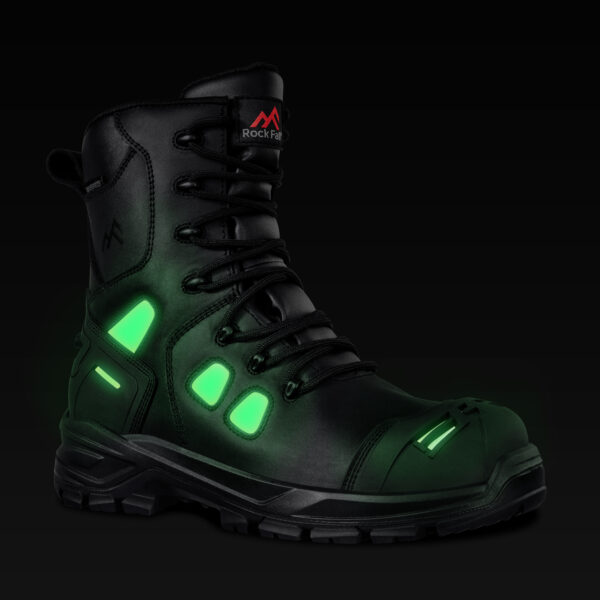
The Canopus RF604 is a 7.4-inch high-leg boot with Signal™ Lucence™ technology plus a side zip for easy on/off. Ideal for workers requiring additional ankle support and coverage.
Key visibility features:
- Glow-in-the-dark phosphorescent panels
- Reflective strips for dual technology coverage
- 360-degree visibility positioning
- S7S waterproof rating
- YBS® side zip
Frequently Asked Questions
What are phosphorescent safety boots? ▶
Phosphorescent safety boots are protective work footwear featuring photoluminescent panels that absorb light energy and emit a visible glow in darkness. Unlike reflective materials that require a light source to work, phosphorescent safety footwear actively emit their own light for up to 8 hours after a 5-minute charge in natural sunlight.
How long do phosphorescent safety boots glow?▶
With Signal™ Lucence™ technology, phosphorescent safety boots glow for up to 8 hours after just 5 minutes of exposure to natural sunlight. Indoor artificial lighting requires approximately 10 minutes to achieve a full charge. Glow intensity is strongest in the first 30 minutes and gradually diminishes while remaining visible throughout the 8-hour period, unless topped up by light sources.
Do glow-in-the-dark safety boots need batteries?▶
No. Phosphorescent safety footwear are completely battery-free and wire-free. They charge automatically by absorbing ambient light energy from sunlight, artificial lighting, or UV sources. There are no batteries to replace, no charging cables, and no electrical components that can fail.
What is the difference between phosphorescent and reflective safety boots?▶
Reflective boots only work when light (such as vehicle headlights) shines directly on them—they reflect light back to its source but produce no light themselves. Phosphorescent safety footwear actively emits their own light in darkness, providing visibility even when there is no external light source. Signal™ Lucence™ dual technology combines both for complete coverage across all lighting conditions.
How do phosphorescent materials work?▶
Phosphorescent materials contain strontium aluminate crystals that absorb photon energy from light sources. This excites electrons to a higher energy state where they become trapped in the crystal lattice. The trapped energy is then slowly released as visible light over several hours, creating the characteristic afterglow effect.
What is Signal™ Lucence™ technology?▶
Signal™ Lucence™ is a dual technology developed by Coats® that combines phosphorescent (glow-in-the-dark) materials with retro-reflective panels. This provides three levels of visibility: fluorescence in daylight, retro-reflectivity when light sources are present, and phosphorescent glow in complete darkness, covering all possible lighting conditions.
What light sources can charge phosphorescent boots?▶
Phosphorescent safety footwear can be charged by direct sunlight (5 minutes for full charge), cloudy daylight (5 minutes), dusk light (8 minutes), fluorescent or LED office lighting (10 minutes), or UV light sources. Natural sunlight provides the fastest and most effective charge, but any light source contributes to charging.
How long does the phosphorescent technology last?▶
The phosphorescent panels in Signal™ Lucence™ safety footwear are designed to last the lifetime of the footwear. Modern strontium aluminate phosphors maintain their charging and glowing capability through thousands of charge cycles without degradation. The technology doesn’t “run out” or require replacement.
The Future of Workplace Visibility
Phosphorescent technology represents a genuine advancement in workplace safety; it’s not a gimmick or novelty, but a practical solution to a real problem. The gap between reflective technology’s requirements and real-world lighting conditions has always existed; phosphorescent materials finally close it.
With Signal™ Lucence™ dual technology, Rock Fall’s Ultimate Visibility range delivers:
- Complete coverage across all lighting conditions
- Zero maintenance visibility technology
- No batteries or electrical failure points
- Proven performance lasting the lifetime of the footwear
When the light fades, you won’t.
Take the Next Step
Ready to experience phosphorescent safety technology? Explore Rock Fall’s Ultimate Visibility range featuring Coats® Signal™ Lucence™ dual technology:
Sirius RF603: 5″ ankle boot with 360° Signal™ Lucence™ panels
Canopus RF604: 7.4″ high-leg boot with 360° Signal™ Lucence™ panels and side zip