Visibility is one of the most critical safety factors for anyone working in low light or complete darkness.
Traditional high-visibility PPE relies on reflective materials that only work when light shines directly on them. But what happens between vehicle passes on a roadside? During a power outage in a warehouse, or in a tunnel or underground space with no artificial lighting?
In these moments, reflective materials can become invisible. Workers may then disappear into the darkness precisely when visibility matters most.
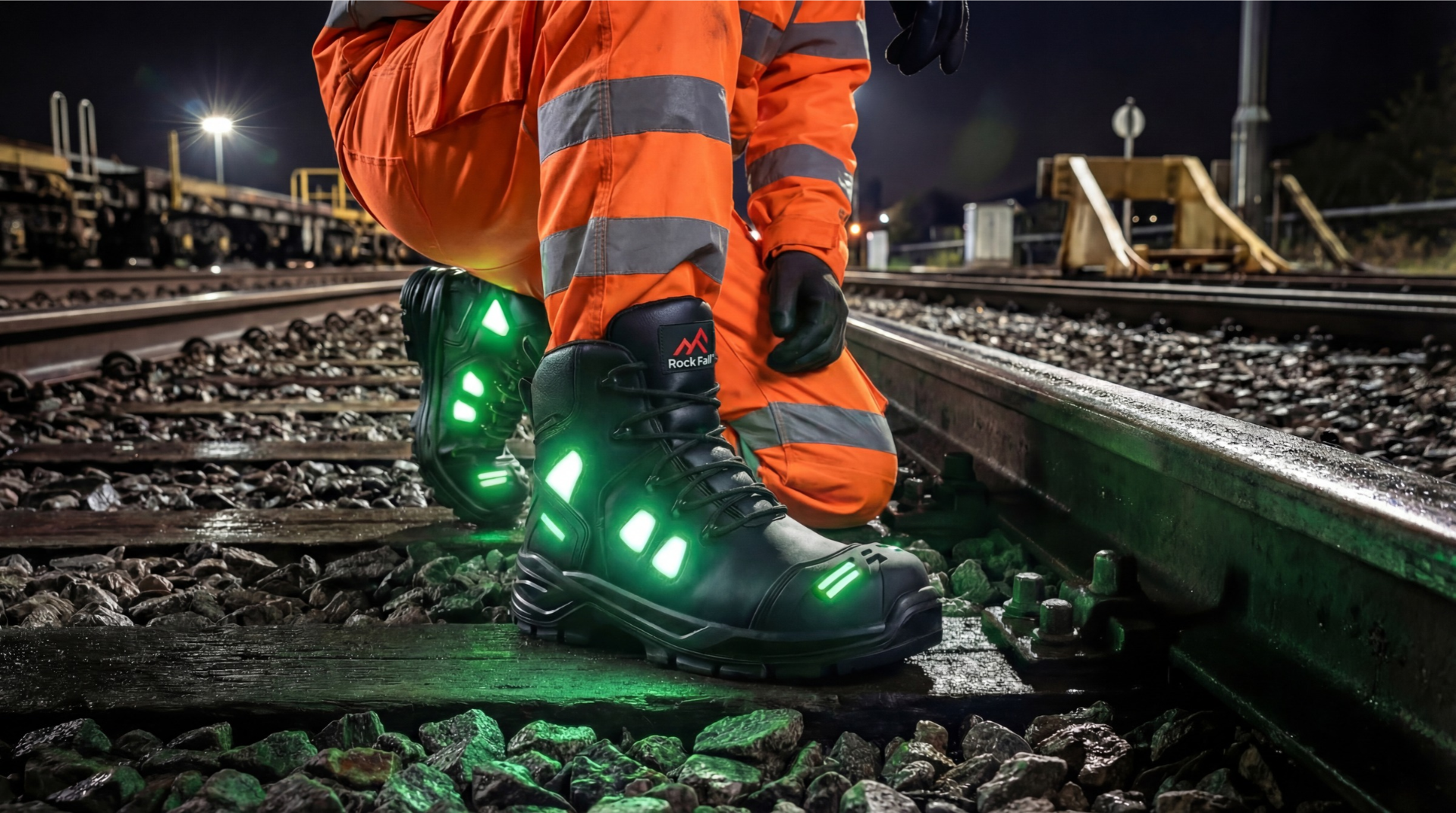
Rock Fall’s phosphorescent ‘Ultimate Visibility’ safety footwear solves this problem. These boots feature photoluminescent panels that absorb light energy and emit a visible afterglow in darkness, keeping workers visible for hours without batteries, without external light sources, and without maintenance.
The Visibility Gap
High-visibility workwear has been standard PPE for decades. Fluorescent fabrics stand out in daylight. Reflective strips bounce headlights and torchlight back to observers. Both technologies save lives every day.
But both have the same limitation: they need light to work.
Fluorescent materials absorb UV light and re-emit it as visible light. They make you more visible in daylight, but in darkness without UV, they don’t help. Reflective materials bounce light back to its source. They make you visible when headlights or torches shine on you, but between those moments, you’re invisible.
This creates a dangerous gap. On a construction site at night, you’re visible when vehicles approach but invisible between passes. During a power outage, your reflective vest does nothing. In tunnels, mines, or underground utilities, you’re unlikely to be visible at the moment when someone’s torch moves away.
The statistics reflect this reality – 25% of all recorded slips & trips have a low visibility component (175 reported monthly – source: HSE). A significant proportion of workplace accidents involving pedestrians and vehicles occur during low-light conditions. Many of these incidents happen not because workers weren’t wearing hi-vis, but because the hi-vis wasn’t visible at the critical moment.
How Phosphorescent Technology Works
Ultimate Visibility phosphorescent safety footwear addresses the visibility gap by actively emitting light rather than reflecting it.
The boots incorporate panels made from photoluminescent materials, specifically strontium aluminate phosphors. These crystals absorb light energy from any source, whether sunlight, artificial lighting, or UV light. The energy excites electrons within the crystal structure, and unlike fluorescent materials that release this energy immediately, phosphorescent materials trap it.
The trapped energy releases slowly over time as visible light. After just five minutes of exposure to natural sunlight, these panels glow for up to eight hours in complete darkness. Indoor lighting takes approximately ten minutes to achieve a full charge.
The result is safety footwear that works when nothing else does. No batteries to fail. No bulbs to replace. No switches to forget. The technology is passive, automatic, and requires no input from the wearer beyond normal light exposure during the working day.
Three Levels of Visibility
The most effective phosphorescent safety footwear doesn’t rely on phosphorescence alone. Rock Fall’s Ultimate Visibility range uses Coats® Signal™ Lucence™ dual technology, which combines phosphorescent panels with reflective materials to provide three distinct levels of visibility.
The first level works in daylight. Fluorescent elements absorb UV light and emit visible light, enhancing daytime visibility just like standard hi-vis materials.
The second level works when artificial light is present. Reflective panels bounce headlights, torchlight, and other light sources back to observers, providing the same protection as conventional reflective workwear.
The third level works in complete darkness. Phosphorescent panels emit stored light energy, keeping the wearer visible even when there’s no external light source whatsoever.
This three-level approach means you’re protected across all lighting conditions. Daylight, artificial light, and no light. There’s no gap where you become invisible.
Who Needs Low Light Protection?
Anyone who works in conditions where visibility can’t be guaranteed needs to consider phosphorescent safety footwear.
Highway maintenance and roadwork present obvious risks. Workers operate alongside live traffic, often at night or in the early hours. Between vehicle passes, there may be seconds of complete darkness on unlit roads. Phosphorescent footwear provides continuous visibility that doesn’t depend on approaching headlights.
Rail infrastructure work frequently occurs at night when services are reduced. Track workers, signalling engineers, and maintenance crews operate in dark depots, tunnels, and trackside environments where lighting is inconsistent or absent.
Utilities workers access underground spaces including cable tunnels, sewers, and service ducts. These environments have limited or no artificial lighting, and the confined spaces make visibility to colleagues especially important.
Construction sites increasingly operate extended hours. Early starts in winter darkness, late finishes, and work in basements or enclosed structures all create low-light conditions. Power outages on site can plunge workers into sudden darkness.
Warehousing and logistics involve loading bays, yard work, and forklift operations that may occur in poorly lit areas. A power outage leaves workers invisible to vehicle operators who may have only emergency lighting.
Emergency services face unpredictable lighting conditions by definition. Incident response, rescue operations, and emergency repairs happen wherever they happen, often without adequate lighting.
Agriculture involves early morning and late evening work, particularly during busy seasons. Fields don’t have street lighting.
Mining and quarrying operations occur underground or in deep pits where natural light doesn’t reach, and artificial lighting may be limited or intermittent.
The Problem with Battery-Powered Alternatives
Some visibility solutions use battery-powered LEDs. These work, but they come with maintenance requirements that phosphorescent technology avoids.
Batteries need charging. If someone forgets to charge their LED workwear, it doesn’t work when needed. Batteries also have limited lifespans and require periodic replacement, adding ongoing cost and maintenance burden.
LEDs can fail. Bulbs burn out, circuits get damaged, water ingress causes shorts. Any electronic system has failure modes that a passive phosphorescent material doesn’t.
Battery-powered solutions add weight and bulk. They need charging infrastructure. They create waste through battery disposal.
Phosphorescent panels have none of these issues. They charge automatically through normal light exposure. They can’t be forgotten or left uncharged. They don’t fail in the way electronic components fail. They require no infrastructure. They produce no waste.
The technology lasts the lifetime of the footwear. Modern strontium aluminate phosphors maintain their charging and emission capabilities through thousands of cycles without degradation.
Rock Fall Ultimate Visibility Range
Rock Fall’s Ultimate Visibility range brings phosphorescent technology to safety footwear through a partnership with Coats® Signal™ Lucence™.
The Sirius RF603 is a 5-inch ankle boot featuring 360-degree Signal™ Lucence™ phosphorescent and reflective panels. It’s designed for workers who need visibility protection without the bulk of a high-leg boot. The 360-degree panel positioning ensures visibility from all angles, whether the wearer is facing toward or away from an observer. The boot carries an S7S waterproof rating, meaning it provides protection against water penetration alongside its visibility features.
The Canopus RF604 is a 7.4-inch high-leg boot with the same Signal™ Lucence™ technology. It includes a durable side zip for easy on and off, making it practical for workers who need to put on and remove boots quickly or frequently. The higher leg provides additional ankle support and coverage for workers in more demanding terrain or conditions. Like the Sirius, it features 360-degree panel positioning and S7S waterproof certification.
Both boots position their phosphorescent and reflective panels at key visibility points: heel counter, side panels, and toe area. This strategic placement ensures the wearer is visible regardless of their orientation to observers. Whether walking toward someone, away from them, or side-on, the panels are visible.
Charging in Practice
One concern people have about phosphorescent footwear is whether it will actually be charged when needed. In practice, charging happens automatically during normal wear.
Outdoor workers get abundant charging simply by being outside. Even on overcast days, ambient daylight provides enough energy for a full charge. Five minutes of daylight exposure is sufficient.
Indoor-to-outdoor workers, such as those in warehouses who move between lit indoor spaces and dark yards, get partial charging from indoor lighting supplemented by any outdoor exposure.
Workers entering dark environments can charge boots before entry using daylight, vehicle headlights, or UV torches. Any time they return to lit areas, the boots top up automatically.
Purely indoor workers get charging from fluorescent and LED lighting throughout their shift. While glow intensity may be lower than sunlight-charged boots, visibility is maintained.
Partial charges still work. Even brief light exposure provides some glow duration, and charging is cumulative. Multiple short exposures add up. You can’t overcharge the boots or damage them through extended light exposure.
Maintaining the Technology
Phosphorescent panels require minimal maintenance. The main consideration is keeping them clean. Dirt, mud, and contamination reduce both light absorption during charging and light emission during use. Clean panels perform better than dirty ones, the same principle as keeping headlights clean.
Clean with warm water and mild soap. Avoid harsh chemicals or solvents on the panels. Don’t abrade panels with stiff brushes. Don’t cover panels with tape, paint, or permanent coatings.
There’s no technology to “wear out” in the traditional sense. The phosphorescent crystals maintain their properties throughout the footwear’s service life. You’ll replace the boots for structural wear long before the phosphorescent technology degrades.
Closing the Gap
Low light and no light conditions present real risks that traditional hi-vis can’t fully address. Reflective materials require external light. Fluorescent materials require UV. Between those conditions lies a gap where workers become invisible.
Rock Fall’s Ultimate Visibility phosphorescent safety footwear closes that gap. By actively emitting stored light energy, these boots keep workers visible in complete darkness, between vehicle passes, during power outages, and in environments where artificial lighting is limited or absent.
The technology is passive, automatic, and maintenance-free. It charges during normal wear, glows for hours, and lasts the lifetime of the footwear.
When the light fades, you won’t.
Rock Fall: safety footwear that works when the light doesn’t. Our Ultimate Visibility range features Coats® Signal™ Lucence™ dual technology, keeping workers visible in the most demanding low-light and no-light environments.